Key takeaways
- Location beats quantity: rust near suspension, steering, brake or seat belt mountings is a structural problem. Rust on an exhaust or an outer wing edge usually isn't.
- Read the trend, not the entry: an advisory that escalates from "slightly corroded" to "excessively corroded" across tests is a car on a countdown.
- A vanished rust fail means welding: if a structural corrosion fail disappears at the retest, ask for the repair invoice. No paperwork, no deal.
A rust advisory on an MOT history looks harmless — the car passed, after all. That's exactly the mistake: buyers skim past the word "corroded", hand over the cash, and meet a welding quote at the very next MOT. This guide shows you how to read every corrosion entry the way a tester writes it, spot the patterns that matter, and know when rust is a bargaining chip versus a reason to walk away.
Why Corrosion Is the MOT Entry Buyers Misread Most
Most MOT advisories describe a part that wears out and gets replaced: a tyre, a wiper blade, a brake disc. Corrosion is different. It only moves in one direction unless someone cuts it out and repairs it — and when it attacks the car's structure, you can't bolt on a new one.
An MOT is a snapshot of one day. A corrosion advisory means the tester saw rust that hasn't yet crossed the line into a fail. Your job as a buyer is to answer two questions: how close to that line is it, and how fast is it moving?
Think of a crack in a house's foundations. One survey noting a hairline crack is worth watching. Three surveys showing the crack widening every year is a different conversation. Would you buy that house without a structural engineer looking at it first?
How MOT Testers Grade Corrosion
Since 20 May 2018, MOT defects have been graded as Dangerous, Major or Minor, with advisories recorded alongside. Minor defects are a pass and are listed on the certificate. For structural rust, though, the three grades below are the ones that decide your purchase. The full criteria are set out in DVSA's MOT inspection manual for cars.
| MOT grade | What it means for corrosion | Key words to look for | Result |
|---|---|---|---|
| Advisory | Rust is present but not yet seriously weakening the structure or component | "slightly corroded", "corroded but not seriously weakening structural integrity" | Pass — monitor closely |
| Major | Corrosion is seriously affecting the strength or rigidity of the structure or component | "excessively corroded" | Fail — must be repaired before retest |
| Dangerous | The structure has insufficient rigidity, or a component is so weakened it's a direct risk to road safety | "excessively corroded" plus "seriously weakened" or a Dangerous label | Fail — illegal to drive until repaired |
Read the scale as a sequence: "slightly corroded" → "corroded" → "excessively corroded" → "seriously weakened". The word "excessively" alone signals a fail. What separates Major from Dangerous is the grade label and phrases like "seriously weakened" — so always check which category the tester ticked, not only the wording.
Reading an older history? Tests before 20 May 2018 don't use the Dangerous/Major/Minor labels. A fail shows as a "reason for rejection", and advisories appear as separate notes. Treat an old corrosion "reason for rejection" on a structural area as you would a Major today.
Why rust near mounting points is judged hardest
The metal around the points where the suspension, steering, brakes, seats and seat belts attach to the body carries the biggest loads — under hard braking, over potholes and in a crash. DVSA treats load-bearing structure within 30cm of these mountings, known as prescribed areas, as especially critical. In practice, rust there is far more likely to be a fail, and far more expensive to repair properly.
If a corrosion entry mentions a sill, subframe, spring mounting or suspension mounting, assume it sits in or near one of these zones.
What a tester can — and can't — see
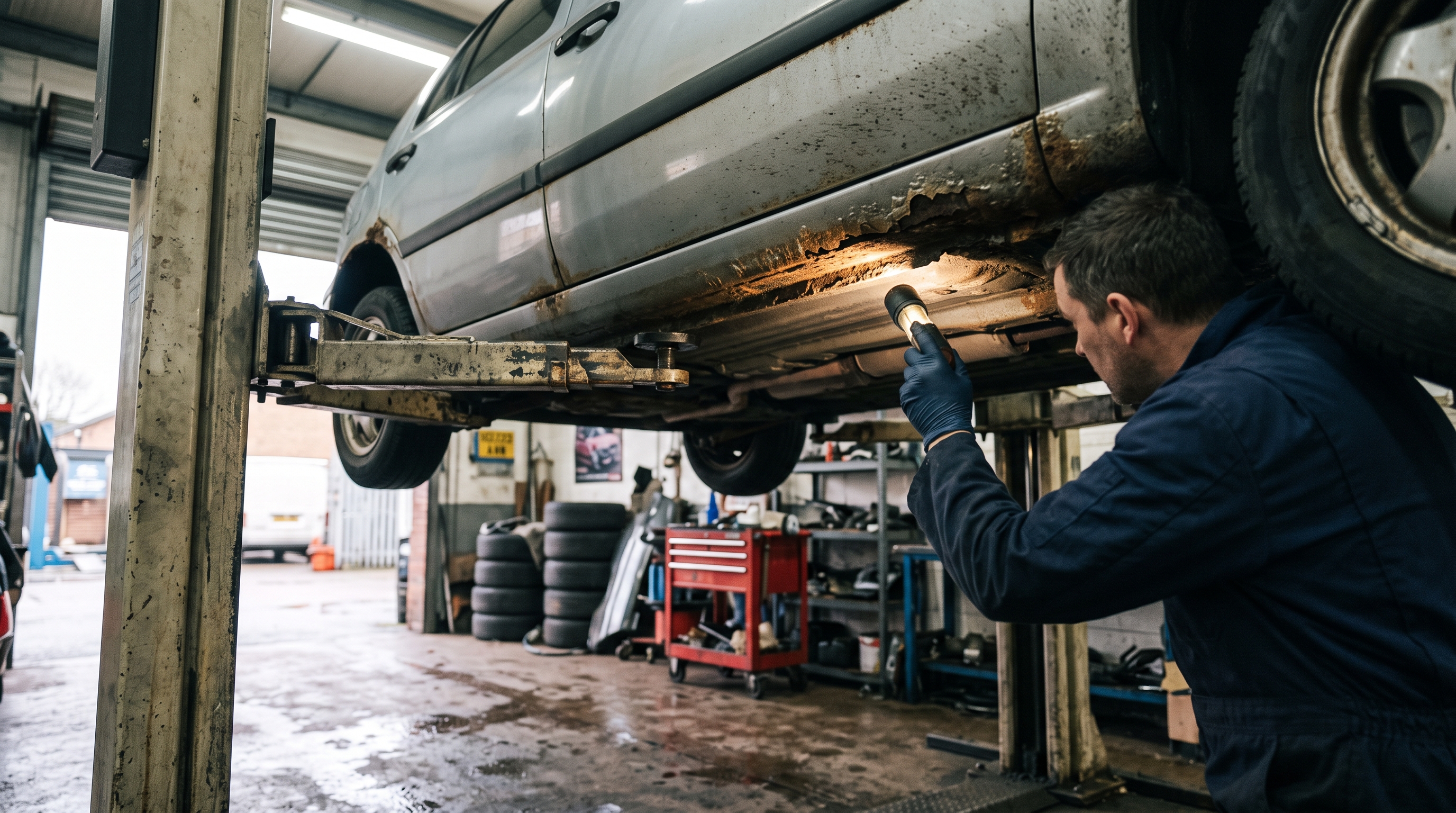
The MOT is a non-dismantling inspection. Testers can apply light pressure with a corrosion assessment tool, but they don't remove trim, panels or protective coatings. A clean MOT therefore means nothing visible crossed the line on test day. It isn't a guarantee that the car is rust-free.
Common mistake
"It passed its MOT, so the rust can't be that bad." An advisory is the tester putting a warning on record. On structural areas, today's advisory is often next year's fail — and the next owner is the one paying for it.
Not All Rust Is Equal: Surface, Scale or Holes?
"Subframe corroded" can describe a light orange film on solid steel or metal that's crumbling away. Once you're looking at the car, the stage of corrosion matters as much as the location.
| Stage | What it looks like | What it usually means |
|---|---|---|
| Surface rust | Even orange-brown discolouration; the metal underneath is solid and keeps its shape | Common on older cars. Often treatable by cleaning back, applying rust treatment and protecting the area. |
| Flaking or scale | Layers of rust lifting off; edges look swollen or thinner than they should | Metal is being lost. Needs a professional assessment; repair or part replacement may follow. |
| Perforation | Holes, or metal that crumbles or flexes when pressed | On structural areas, a fail. Requires welding or a replacement part. |
This is why a subframe advisory on its own isn't an automatic walk-away. A subframe with surface rust that has stayed stable for years is a different car from one that's flaking at the mountings.
Location Is Everything: Where Rust Becomes a Deal-Breaker
Use this table to translate the location in an MOT entry into a risk level and a specific check at the viewing.
| Location in the entry | Structural? | Risk | What to check at the viewing |
|---|---|---|---|
| Sills and jacking points | Yes | High | Torch the full length of both sills. Look for bubbling paint, crusty edges, filler or patches newer than the rest. |
| Subframe and its mountings | Yes | High | Torch the mounting points. Use the stages above: surface rust is manageable; flaking or holes are serious. |
| Suspension mountings, strut tops, spring seats | Yes | High | Check the strut tops under the bonnet and the inner rear arches for scaling or bubbling. |
| Floor pan, boot floor, spare wheel well | Often | Medium–high | Lift the boot carpet. Damp, standing water or rust stains point to leaks feeding corrosion. |
| Brake pipes | Safety component | Medium | Follow the pipes along the underside. Heavy scaling or swelling means replacement soon — budget for it. |
| Coil springs | Component | Medium | Corroded springs can break. Look for heavy rust on the coils behind each wheel. |
| Outer wheel arches, door bottoms | Usually not | Low–medium | Mostly cosmetic and a value issue. Open every door and check the lower edges and drain holes. |
| Exhaust system | No | Low | A replaceable part. Surface rust is normal. Listen for blowing or rattling at idle. |
Read the Trend, Not the Entry: 5 Corrosion Patterns
A single corrosion advisory tells you very little. Line up every MOT test side by side and the story appears.
1. The stable advisory
Same location, same wording, several years running, never escalating. The corrosion is likely progressing slowly. Proceed with caution: inspect the area yourself and factor a future repair into your offer.
2. The escalating language
"Slightly corroded" one year, "corroded" the next, then "excessively corroded" as a fail. This is a countdown. If the latest test shows the advisory stage on a structural area, you may be the owner who pays for the fail.
3. The spreading rust
One location in the first test, three or four by the latest. Corrosion appearing across sills, subframe and floor suggests years of salted roads or outdoor storage. Unless it's priced as a project, this is walk-away territory.
4. The fail-then-pass
A structural corrosion fail, followed by a pass days later with the item gone. Repair work was done — almost certainly welding or a replacement part. That can be a positive. Ask for the invoice and, ideally, photos of the work. A neat repair with paperwork is fine. A patch plated over rotten metal is a problem waiting for the next test.
5. The vanishing advisory
A corrosion advisory appears for a year or two, then disappears without a fail in between. Either the area was repaired, or it was covered up. Ask directly: "What was done about the sill advisory from last year?" A vague answer is your answer.
Warning: fresh underseal on an older car
Underseal is legitimate rust protection on sound metal. Applied over existing corrosion, it hides the problem from you and from the next MOT tester, who isn't allowed to scrape it off. Thick, glossy, recently applied underseal on a car with a history of corrosion advisories should raise questions, not reassure you.
Three MOT Scenarios: How the Verdict Changes
The examples below are illustrative, built from patterns that commonly appear in UK MOT histories. They show how the same word — "corroded" — can lead to three very different decisions.
Scenario A: Small hatchback, 2011
- 2023 — Pass. Advisory: nearside sill corroded but not seriously weakening structural integrity.
- 2024 — Pass. Same advisory, same wording.
- 2025 — Pass. Same advisory, same wording.
Verdict: Proceed with caution. Stable, one location, no escalation in three years. Check whether it's surface rust or flaking, get a repair quote from a local garage, and use it in your negotiation.
Scenario B: Family estate, 2013
- 2023 — Pass. Advisory: underside slightly corroded.
- 2024 — Pass. Advisories: rear subframe corroded; brake pipes corroded.
- 2025 — Fail. Major: rear subframe excessively corroded; nearside rear brake pipe excessively corroded. Passed retest six days later.
Verdict: Proceed with caution — only with paperwork. The escalation was textbook, but it was fixed. With an invoice showing a replaced or properly repaired subframe and new brake pipes, this can be a decent buy. Without proof of what was done, walk away.
Scenario C: People carrier, 2009
- 2023 — Pass. Advisories: both sills corroded; front subframe corroded; floor corroded.
- 2024 — Fail. Major: both sills and front subframe excessively corroded within prescribed areas. Passed the same day with no advisories at all.
- 2025 — Pass. Advisory noting the underside was obscured by underseal.
Verdict: Walk away. Widespread structural rust, a same-day pass with every corrosion note wiped clean, and an underside the tester could no longer see. Unless a specialist puts it on a ramp and confirms quality repairs, the risk sits entirely with you.
Your 6-Step Rust Check: From Phone to Viewing
- Before you travel, read the whole history. Write down every location mentioned for corrosion and the wording used in each year.
- Identify the pattern. Stable, escalating, spreading, fail-then-pass or vanishing? This tells you how hard to look and which questions to ask.
- At the viewing, go to the listed areas first. Bring a strong torch, gloves and an old mat to kneel on. Use the location table above for what to look for.
- Judge the stage. Surface discolouration, flaking layers or holes? That decides whether you negotiate or leave.
- Look for disguise. Fresh underseal, new paint on the sills, or a fridge magnet that won't stick where it should — a sign of body filler.
- Ask the right question. "Has any welding been done, and do you have the invoice?" Watch how the seller answers as much as what they say.
Safety warning
Never crawl under a car supported only by a jack. Inspect from the side with a torch, or pay for a professional inspection on a ramp. If the MOT history shows structural corrosion, a ramp inspection is worth every penny before you commit.
When Rust Means Walk Away — and When It Doesn't
| Walk away when… | Negotiate (or relax) when… |
|---|---|
| A structural corrosion fail was "fixed" with no invoice or evidence | Structural repairs were done professionally and the seller has paperwork |
| Flaking or holes in sills, subframe or suspension mountings | Surface rust on solid metal that has stayed stable for several years |
| Sill or subframe wording escalates test after test, or spreads to new areas | Brake pipe advisories you can price as a repair before you buy |
| Fresh underseal or filler on a car with a corrosion history | Surface rust on the exhaust or other replaceable parts |
| The seller is vague or evasive about past advisories | Cosmetic bubbling on outer panels, reflected in the asking price |
Turn Corrosion Advisories Into a Lower Price
A corrosion advisory on a non-critical area isn't only a risk — it's leverage. The tester has already put the problem on an official record, so the seller can't wave it away.
- Get a quote before you negotiate. Ring a local garage or welding specialist with the exact MOT wording and ask for a rough price.
- Offer two options. The seller fixes it before sale with an invoice, or reduces the price by the quoted amount.
- Know your ceiling. If the repair cost would eat most of the discount compared with a cleaner example, you're buying someone else's problem.
What the MOT History Can't Tell You About Rust
The MOT history records what a tester saw on the day. It doesn't tell you whether structural damage came from an accident rather than corrosion, whether the car carries an insurance write-off category such as S or N, or whether there's outstanding finance on it. For those, run an HPI-style check alongside your MOT history review. For hidden corrosion, nothing beats a physical inspection on a ramp.
Frequently Asked Questions
Can a car fail its MOT for rust?
Yes. Corrosion that seriously affects the strength or rigidity of the structure, or of a component such as a brake pipe, is a Major or Dangerous defect and fails the test. Lighter corrosion is recorded as an advisory and the car passes.
Is "corroded but not seriously weakening structural integrity" a reason not to buy?
Not on its own. It's a pass with a warning. What matters is whether the same entry repeats unchanged, escalates, or spreads across tests, and whether the rust you see at the viewing is surface-level or flaking.
Can I check a car's MOT history before I go to see it?
Yes. MOT history is free to view on GOV.UK using the registration number. Do it before you travel, so you know exactly which areas to inspect and which questions to ask.
Does surface rust on the exhaust matter when buying a used car?
Usually not. The exhaust is a replaceable part and surface rust is normal on older cars. It only becomes an MOT issue if the system leaks, is insecure, or affects emissions.
What if the seller has no invoice for welding work?
Treat the repair as unknown. A welded car isn't automatically a bad buy, but without paperwork you can't tell a proper repair from a patch over rotten metal. Either get the car inspected on a ramp before you commit, or walk away — especially if the original fail was in a structural area.
Will an MOT tester spot all the rust on a car?
No. The MOT is a non-dismantling inspection, so corrosion hidden behind trim, panels or coatings may not be recorded. A clean MOT history is a good sign, not a guarantee.
Should I walk away from a car with brake pipe corrosion advisories?
Not necessarily. Brake pipes are safety-critical but replaceable, so an advisory is a repair to budget for rather than an automatic deal-breaker. If the pipes were marked as excessively corroded or seriously weakened and the seller can't show they were replaced, treat that as a serious red flag.
Found rust on the MOT history? Get the full picture before you buy.
Paste the reg plate into MOTVerdict and get an AI verdict in under 60 seconds — corrosion trends, mileage history and red flags translated into a clear answer: Good Buy, Proceed with Caution, or Walk Away.
GET MY AI VERDICT →Sources: DVSA, MOT inspection manual: cars and passenger vehicles; GOV.UK, Check the MOT history of a vehicle.
Disclaimer: This article is for informational purposes only and is based on how DVSA MOT test records are structured and graded. The scenarios shown are illustrative. MOT history does not cover outstanding finance, insurance write-off categories or theft status, and it is not a substitute for a full physical mechanical inspection or an HPI-style vehicle history check. Always inspect a vehicle thoroughly, or have it inspected by a qualified professional, before purchase.