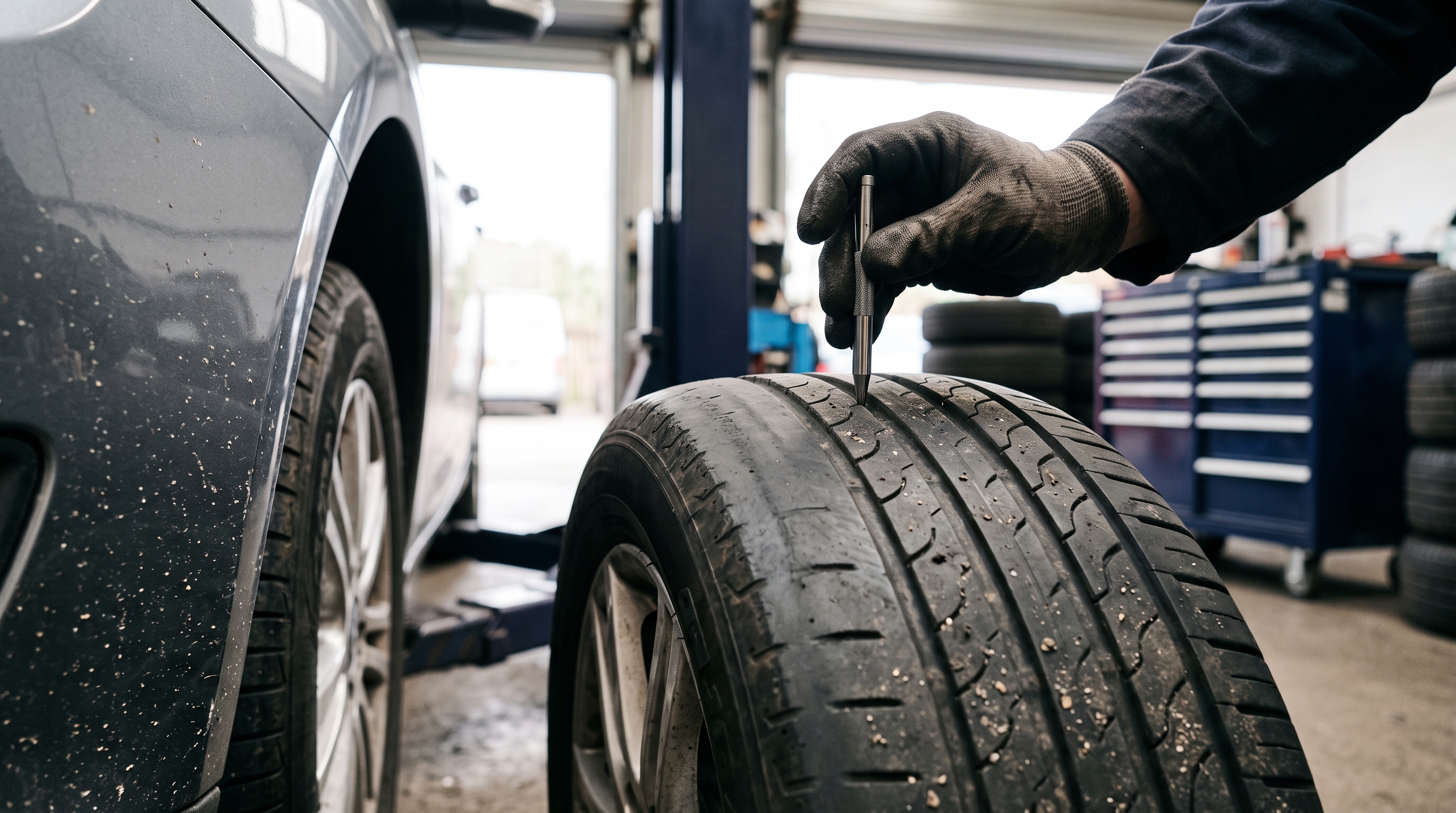
Maintenance · Key takeaways
- A tyre advisory is a symptom, not the problem. Uneven wear usually points to alignment or suspension faults that new tyres alone will not fix.
- The pattern across years matters more than any single entry. Repeat advisories on the same corner tell you how the car has been maintained.
- Price the cause, not just the rubber. A front alignment averages around £40–£50. Skipping it can cost you a pair of tyres.
In this guide
Most buyers scroll past a tyre advisory on an MOT history and think, "Tyres are cheap, I'll sort that." That is the mistake. A tyre is the only part of the car that touches the road, so its wear pattern is a written record of the alignment, the suspension and the owner's habits. Read the advisories correctly and you will know whether you are looking at a car that needs two new tyres or one that will eat through every set you fit.
This guide covers MOT testing in Great Britain and UK tyre law.
Why a tyre advisory tells you more than the tyre itself
A tyre on a healthy car wears evenly across its width, slowly, over thousands of miles. When an MOT tester writes "worn on edge" or "worn close to legal limit", they are recording one measurement on one day. What you want to know is why the tyre got there.
Think of it like the sole of a shoe. If the heel is worn flat on one side, new shoes will not stop it happening again, because the cause is in how you walk. On a car, the cause sits in parts you cannot see on a viewing. So the real question is: what is this tyre telling me about everything around it?
Even wear
Healthy alignment and pressures
Inner-edge wear
Alignment or worn suspension parts
Both shoulders
Run under-inflated for long periods
Centre worn
Run over-inflated for long periods
Tread cross-sections. The dashed line marks new tread depth. Edge wear on one side is the pattern that most often points to a mechanical fault.
How the MOT grades tyre problems
Every tyre issue on a DVSA MOT record falls into one of the standard defect categories. The category tells you whether the car passed, failed, or should not have been driven at all.
| Category | Typical tyre wording | What it means for the test |
|---|---|---|
| Advisory | "Tyre worn close to legal limit", "worn on edge", "slightly damaged/cracking or perishing" | Pass. The tester is warning that the tyre needs monitoring and will likely need replacing soon. |
| Major | "Tread depth below requirements of 1.6mm", "lump, bulge or tear", TPMS warning lamp on (cars first used from 1 January 2012) | Fail. The defect must be repaired before the car can pass a retest. |
| Dangerous | "Ply or cord exposed" | Fail. It is illegal to drive the car away until the tyre is replaced. |
The UK legal minimum tread depth for a car is 1.6mm across the central three-quarters of the tread, around the entire circumference. Driving on tyres below that limit can lead to a fine of up to £2,500 and three penalty points per illegal tyre. Four illegal tyres can mean enough points for a ban.
The 5 tyre advisory patterns that reveal what a car has been through
A single tyre advisory on a ten-year-old car is normal, because tyres wear out. These are the patterns worth slowing down for.
1. Inner or outer edge wear on the front tyres
"Worn on inner edge" or "worn on outer edge" means the tyre is not sitting flat on the road. The usual causes are incorrect wheel alignment (tracking or camber), worn suspension bushes, worn track rod ends, or a past hit on a kerb or pothole. This is the pattern behind most of the advice in this guide: the tyre is the visible symptom, and the fault sits in the parts holding the wheel.
2. The same tyre flagged at two or more consecutive MOTs
If the nearside front tyre is "worn close to legal limit" one year and shows the same advisory, or a fail, the next, the owner ran it down rather than replacing it. Ask yourself: if they let the tyres go, what else did they let go? Check the service history and any brake advisories with that in mind.
3. Cracking or perishing
"Slightly damaged/cracking or perishing" usually points to age, sun exposure or long periods parked. Rubber degrades with time even when the tread looks deep. Compare it with the mileage history. Perishing on a car covering very few miles a year often means it sat unused, which brings its own risks to the brakes and battery.
4. Wear concentrated on one corner only
If three tyres are fine and one keeps appearing on the record, the problem is local to that corner: a bent wheel, a damaged suspension component or a previous impact. Inspect that wheel for kerb damage and ask whether that side has had any accident or suspension repair.
5. Tyre advisories next to suspension or steering advisories
This is the strongest signal of all. "Offside front tyre worn on inner edge" in the same test as "Offside front suspension arm rear bush worn" or "Track rod end ball joint has slight play" is one connected story. You are budgeting for parts, an alignment and tyres, not tyres alone.
Common mistake
"It just needs two front tyres, I'll knock that off the price." If the cause is alignment or a worn component, a fresh pair will wear the same way. You pay for tyres twice and still have the fault.
Worked examples: three MOT patterns and what they mean
The records below are illustrative examples built from standard DVSA advisory wording. They show how to read a sequence, not a specific vehicle.
Example A: a clean story
2023 test (Pass): Nearside front tyre worn close to legal limit.
2024 test (Pass), +9,800 miles: No tyre advisories.
Reading: the tyre was replaced between tests. One advisory followed by a clean record shows an owner who acts on warnings. That is a positive, not a red flag.
Example B: the fault that was never fixed
2022 test (Pass): Offside front tyre worn on inner edge.
2023 test (Pass): Offside front tyre worn on inner edge. Offside front suspension arm rear bush worn.
2024 test (Fail): Offside front tyre tread depth below requirements of 1.6mm.
Reading: three years, one corner, one problem getting worse. A new tyre will have been fitted for the retest, but nothing on the record shows the bush or alignment were dealt with. No invoice from the seller means you budget for both.
Example C: perishing on a low-mileage car
2022 test: 41,200 miles.
2023 test: 42,100 miles.
2024 test: 42,700 miles. Advisories on all four tyres: slightly damaged/cracking or perishing.
Reading: around 1,500 miles in two years, plus perishing on every tyre, suggests the car has mostly been parked. Check the tyre date codes, look at the brake discs for heavy corrosion and ask how the battery was kept charged. Low mileage only adds value if the car was looked after while it sat.
What a tyre advisory can really cost you
Here is where "price the cause" turns into pounds. The figures below are indicative UK averages. Large wheels, run-flat tyres and premium brands cost more, so always get a quote for the specific car.
| Job | Indicative UK cost | When you need it |
|---|---|---|
| Front wheel alignment | Around £40–£50 on average | Any front edge-wear advisory, and whenever new front tyres go on |
| Four-wheel alignment | Around £80–£90 on average | Edge wear on the rear tyres, or after suspension work |
| Mid-range tyre, common size | Roughly £75–£120 per tyre | "Worn close to legal limit", perishing, or damage |
| Suspension bush or track rod end | Varies widely by model | Tyre advisory paired with a suspension or steering advisory. Get a quote before you make an offer. |
Run the numbers on Example B. Two mid-range front tyres come to roughly £150–£240. Fit them without fixing the bush and alignment, and you could be buying them again well ahead of schedule. Add a front alignment at around £40–£50, plus the bush quote, and you have the real figure to negotiate with.
Warning
An MOT pass is a snapshot of the test day, not a guarantee of the tyres you are looking at today. A car that passed eleven months ago with "worn close to legal limit" may now be below 1.6mm. Drive it home on illegal tyres and the fine and penalty points are yours. Check the tread before you hand over money.
Your tyre checklist for the viewing
Once the MOT history has told you where to look, these checks take about ten minutes on the driveway.
- Measure the tread at the inner edge, centre and outer edge of every tyre. A tread depth gauge is cheap and far more reliable than eyeballing it. Compare what you find with the diagram above.
- Find the tread wear indicators. Small raised bars in the main grooves sit at 1.6mm. Tread level with them means the tyre is at the legal limit.
- Read the date code on the sidewall (see below).
- Check the sidewalls. Look for bulges, cuts, cracks and kerb scuffs on the tyre and the wheel rim.
- Look at what is fitted. A mix of mismatched budget tyres across the car often reflects cost-cutting ownership. Matching quality tyres on each axle is a better sign.
- Check the spare wheel or inflation kit. The MOT does not test the spare, so it never appears in the history.
- Watch the dashboard. On cars first used from 1 January 2012, a lit tyre pressure monitoring (TPMS) warning is an MOT fail.
- Feel it on the test drive. Pulling to one side, an off-centre steering wheel on a straight road or vibration at motorway speeds all support an alignment or wheel problem.
Sidewall code
2219
How to read a tyre date code
Find the four digits at the end of the DOT code on the sidewall. The first two are the week, the last two the year of manufacture. 2219 means week 22 of 2019. Old rubber plus a perishing advisory is a budget item, whatever the tread depth.
Questions to ask the seller
- "The MOT shows inner-edge wear on the front. Has the alignment been checked since, and do you have the printout?"
- "When were these tyres fitted, and do you have the invoice?"
- "The suspension bush advisory from last year: was it replaced, and by whom?"
- "Has the car hit a kerb or pothole hard, or had any suspension or steering repair on that side?"
- "How has the car been used? Daily, or did it sit for long periods?"
A seller with receipts and clear answers is reassuring. Vague answers to specific questions are information too.
How tyre advisories should shape your offer
Not every tyre advisory deserves the same reaction. Use the pattern to decide how much weight to give it.
| Pattern on the MOT history | Risk level | What to do |
|---|---|---|
| One advisory, cleared at the next test | Low | Normal wear and replacement. Check current tread and move on. |
| Same tyre flagged at consecutive tests | Medium | Treat it as a maintenance-habit signal. Look harder at the service history and other repeat advisories. |
| Repeated edge wear, no suspension advisories | Medium | Ask for alignment evidence. If none, deduct an alignment and any tyres below about half their tread. |
| Edge wear plus suspension or steering advisories | High | Get a mechanic to inspect before buying. Negotiate on the full quote: parts, alignment and tyres. |
| Perishing on all tyres, very low annual mileage | Medium | Check date codes, brakes and battery. Budget for a full set of tyres if they are old. |
| Dangerous tyre defect in the history | High | Someone drove on a tyre with exposed cord. Read the rest of the history closely for other signs of neglect. |
The rule of thumb: tyres are a consumable, but a tyre-eating car is a fault. Pay a fair price for the first. Make the seller carry the cost of the second.
Frequently asked questions
Does a tyre advisory mean the car failed its MOT?
No. An advisory is recorded on a pass. It means the tester saw wear or minor damage that is not yet a defect but should be monitored and dealt with soon.
What does "worn on edge" mean on an MOT history?
It means the tyre has worn more on its inner or outer shoulder than across the centre. One-sided edge wear usually points to wheel alignment problems, worn suspension or steering components, or a past impact, rather than normal use.
Is it illegal to drive on tyres below 1.6mm?
Yes. A car's tyres must have at least 1.6mm of tread across the central three-quarters of the tread and around the full circumference. Each illegal tyre can bring a fine of up to £2,500 and three penalty points.
How much does a wheel alignment cost in the UK?
A front wheel alignment averages around £40–£50, and a four-wheel alignment around £80–£90, depending on the car and the garage. That is usually far less than the tyres a misaligned car can wear out.
How old is too old for a car tyre?
There is no legal age limit for tyres on private cars in the UK. The ban on tyres aged ten years or more applies to the front steered axles of lorries, buses and coaches, not cars. Even so, rubber degrades over time, so check the date code and treat cracking or perishing seriously on older tyres.
Can I tell from the MOT history whether tyres were replaced?
Not directly, because the MOT does not record repairs. An advisory that disappears at the next test, with normal mileage in between, strongly suggests the tyre was replaced. The same advisory returning on the same corner suggests it was not.
Does MOTVerdict pick up tyre advisories?
Yes. MOTVerdict reads the full DVSA MOT history, flags advisories in amber and dangerous defects in red, and reads them alongside mileage and other advisories so you see the pattern, not just a list of entries.
Before you view the car
See every tyre advisory in context, not in isolation
Paste the reg plate and get a clear AI verdict in under 60 seconds: Good Buy, Proceed with Caution, or Walk Away. Repeat advisories, mileage history and questions to ask the seller, all in one report.
CHECK A REG PLATE NOW →Built on official DVSA MOT history data
Disclaimer: This article is for informational purposes only and is based on publicly available DVSA MOT records and UK road traffic rules. Example MOT records are illustrative. Repair costs are indicative UK averages drawn from garage-booking platforms and motoring organisations (2025–2026) and will vary by vehicle, region and garage. MOT history does not replace a full physical inspection by a qualified mechanic, and it does not cover outstanding finance, insurance write-off categories or theft status. For those, use an HPI-style vehicle history check alongside your MOT analysis.