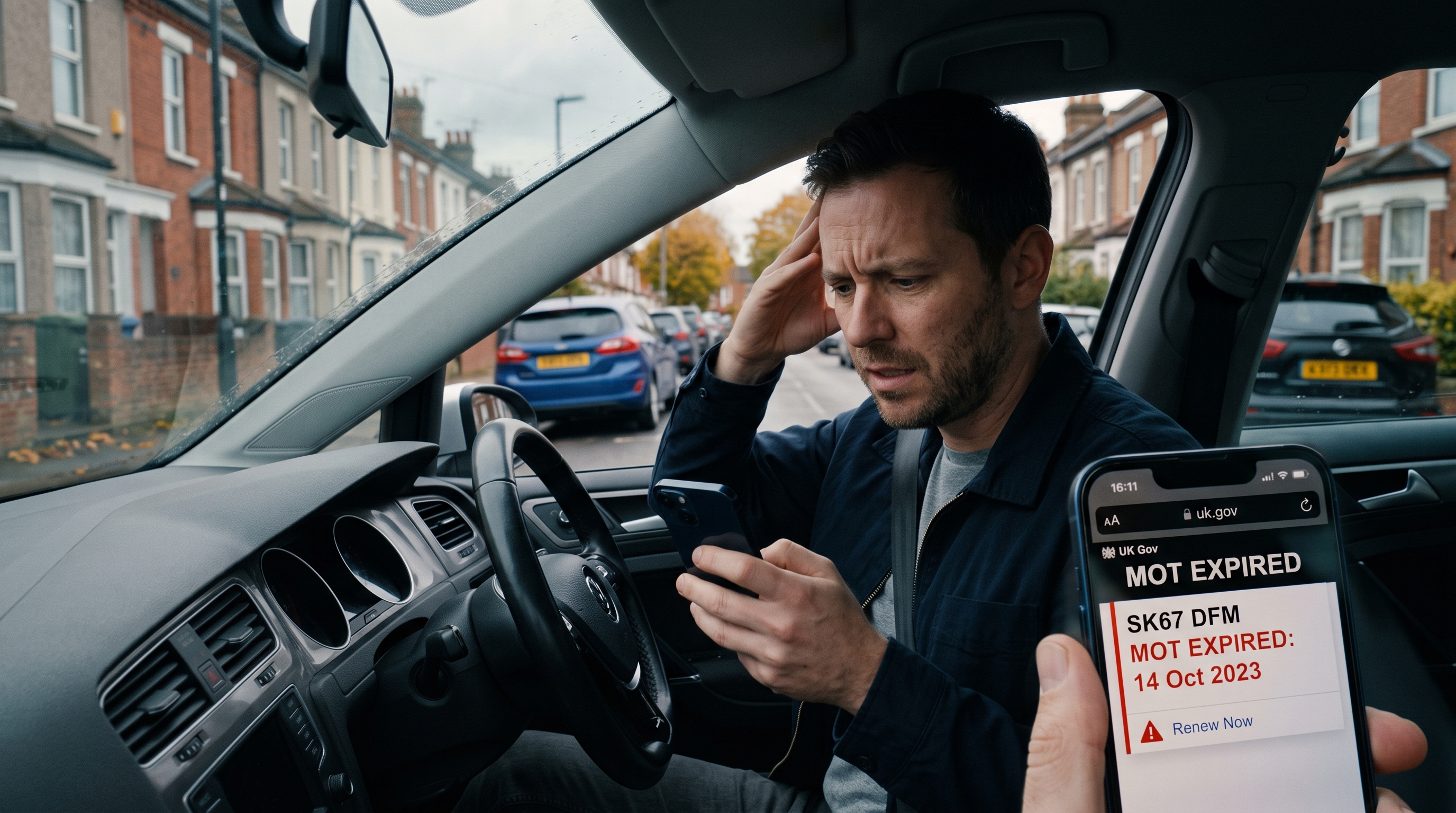
Key Takeaways
- There is no grace period — your MOT expires at midnight and you're immediately breaking the law.
- A single expired MOT can trigger two separate offences: driving without an MOT and potentially driving without valid insurance.
- ANPR cameras submit over 100 million plate reads per day — "quiet roads" are no longer a realistic hiding place.
Your MOT expired last week. It's a five-minute drive, quiet roads, no police in sight. What's the worst that could happen?
More than most drivers realise. Driving without a valid MOT isn't a minor paperwork slip — it can void your insurance in the worst possible moment, hand you a court fine of up to £1,000, and flag your plate to 12,000 cameras before you've reached the end of your street. This guide covers every consequence, the one narrow legal exception, and the "grace period" myth that keeps costing people money.
Is It Illegal to Drive Without an MOT?
Yes — without qualification. Under the Road Traffic Act 1988, any vehicle over three years old must hold a valid MOT certificate to be driven on a public road. The moment your certificate expires, you are committing an offence — regardless of the vehicle's actual condition, how far you're travelling, or what time of day it is.
In Northern Ireland, the rules are administered by the DVA (Driver and Vehicle Agency) rather than the DVSA, and the MOT requirement applies from four years old rather than three. The penalties are identical.
⚠️ There is no grace period.
Many drivers believe there's a short window after expiry when driving is still technically legal. There isn't. The second your MOT expires, you are committing an offence — regardless of how roadworthy your vehicle is or how short the journey.
What Are the Penalties for Driving Without an MOT?
The consequences scale with two factors: the condition of the vehicle, and whether your case stays at the roadside or reaches a Magistrates' Court.
| Situation | On-the-spot FPN | Max court fine | Penalty points |
|---|---|---|---|
| MOT expired — no dangerous faults | £100 | Up to £1,000 | None (typically) |
| Driving with a dangerous defect | Variable | Up to £2,500 | 3 points + possible ban |
Source: GOV.UK / DVSA guidance.
If stopped by police, you'll typically receive a Fixed Penalty Notice of £100 on the spot. The £1,000 figure is the maximum a Magistrates' Court can impose — reserved for repeat offenders or more serious circumstances.
🚨 Repeat offenders face escalating consequences.
Two no-MOT convictions within three years can result in a six-month driving ban — even if your car had no dangerous faults on either occasion.
The Risk Most Drivers Underestimate: Your Insurance
A fine stings. What can truly derail you financially is what happens to your insurance cover — and most drivers don't consider this until after an accident.
Most UK motor insurance policies require your vehicle to be roadworthy and legally compliant at all times. Driving without a valid MOT can breach those terms. If you're involved in a collision, your insurer may refuse to pay out — particularly where the lapsed MOT was connected to the cause of the incident.
Consider how this plays out in practice. Your brakes are worn. You haven't had an MOT. You're in a rear-end collision. Your insurer investigates, finds the brakes would have failed a test, and argues the missing certificate is directly relevant to the claim. You're now in a dispute — and the burden of arguing your case falls on you, not them.
The Financial Ombudsman Service (FOS) assesses each case individually and has ruled that insurers cannot automatically void third-party claims solely because a vehicle had no MOT. But outcomes vary, and a prolonged dispute is a realistic outcome even when you're ultimately in the right.
There's a further complication. Driving without valid insurance is a separate offence to driving without an MOT. If an insurer dispute leads down that route, the additional consequences can include:
- A fine of up to £300 (or unlimited if prosecuted in court)
- 6–8 penalty points on your licence
- Possible disqualification from driving
- Vehicle seizure
One expired MOT. Potentially two separate offences. A very costly day.
How ANPR Cameras Catch Drivers Without an MOT
There's a common assumption that driving short distances without an MOT is low-risk — a school run, an early commute, a quick trip to the garage. ANPR technology has made that assumption dangerous.
Automatic Number Plate Recognition (ANPR) cameras — mounted on roads, motorways, and police vehicles across the country — scan plates and cross-reference them against DVLA and DVSA databases in real time. If your MOT has expired, your vehicle is flagged the moment it passes a camera.
According to the Home Office's National ANPR Service data protection impact assessment (2024), the UK network comprises over 12,000 fixed camera sets and 1,800 mobile units, submitting more than 100 million plate reads to national systems every single day. You don't need to be speeding. You don't need to be acting suspiciously. Simply passing the wrong camera on the way to the supermarket is enough — and many drivers don't realise they've been flagged until a Fixed Penalty Notice arrives in the post.
📷 There is no such thing as a "quiet road" anymore.
With over 100 million daily plate reads submitted to national systems, the question isn't whether cameras will see your car — it's when.
When Can You Legally Drive Without an MOT?
There is one legal exception — and it's narrow, specific, and frequently misapplied.
✅ The legal exception
If your vehicle has failed its MOT, you may drive it to a pre-booked appointment to have the specific MOT-related faults repaired — provided no dangerous defects are present. You may also drive directly to a pre-booked MOT test. In both cases, you must travel directly with no detours, and no dangerous defects may be present.
This does not mean you can drive to a garage for general maintenance simply because your MOT has lapsed. The exception covers repairing faults identified during a failed MOT test — not routine servicing, and not a vehicle whose MOT has simply expired without a test taking place.
Key conditions:
- The MOT test or repair appointment must be pre-booked
- The vehicle must have no dangerous defects
- You must travel directly — no detours or additional journeys
- You cannot use this exception for general maintenance on a lapsed MOT
- If dangerous defects are present, the vehicle must be transported — not driven
The "MOT Grace Period" Myth — Debunked
Search online and you'll find this repeated confidently in forum after forum: a supposed window of a few days after expiry when you can still legally drive. This is entirely false.
The confusion stems from a legitimate (but completely different) rule: you can renew your MOT up to a calendar month before expiry and keep your original renewal date. That means if your MOT expires on 30 September and you test on 1 September, your new certificate runs to 30 September next year — not just 1 September. That's the "grace period" people are misremembering. It applies before expiry. It does not create any window after expiry.
The moment your MOT certificate lapses — typically at midnight on the expiry date — you are committing an offence by driving on a public road. There is no informal tolerance, no police discretion window, and no DVSA grace allowance.
What to Do If Your MOT Has Already Expired
Act immediately. The longer you delay, the greater your exposure.
- Stop driving the vehicle on public roads — except to travel directly to a pre-booked test or repair appointment (no dangerous defects present).
- Check your exact expiry date using the free DVSA tool on GOV.UK — you only need your registration number.
- Book your MOT test at an approved test centre as soon as possible. Once booked, you can drive directly to the test centre provided no dangerous defects are present.
- Arrange transport if needed — if the vehicle has dangerous defects or you're unsure, arrange recovery rather than driving it.
Know What's In Your Car's MOT History Before You Buy
If you're buying a used car, the seller's word on MOT status means nothing without verification. A car can be presented as roadworthy, recently tested, and low mileage — and still be hiding a string of dangerous advisories, a mileage discrepancy, or a lapsed certificate that was never renewed after a failure.
The DVSA MOT history tells you every test result, every advisory, every recorded mileage reading, and every failure reason going back years. That's the data MOTVerdict runs its AI verdict on — translating raw test records into a plain-English answer: buy it, proceed with caution, or walk away.
MOTVerdict
Is the car you're buying hiding something?
Paste a UK registration plate and get an AI verdict on the full MOT history — mileage anomalies, dangerous advisories, and failure patterns — in under 60 seconds.
GET MY AI VERDICT →Frequently Asked Questions
Can I drive without an MOT if my car is roadworthy?
No. Roadworthiness and MOT validity are separate legal requirements. A vehicle over three years old must hold a valid MOT certificate to be driven on a public road — regardless of its actual condition. The law does not provide a "common sense" exemption.
What is the fine for driving without an MOT in the UK?
A Fixed Penalty Notice of £100 on the spot. If the case reaches a Magistrates' Court, the maximum fine is £1,000. Driving a vehicle with dangerous defects is a separate offence carrying a maximum fine of £2,500 and 3 penalty points.
Does driving without an MOT void my insurance?
Not automatically — but it can seriously undermine your cover. If you're in an accident and your insurer determines the lapsed MOT was connected to the cause, they may refuse to pay out. The Financial Ombudsman Service has ruled that insurers cannot automatically void third-party claims on this basis alone — but individual case outcomes vary, and disputes are a realistic risk.
Is there a grace period after my MOT expires?
No. There is no legal grace period after MOT expiry. The confusion comes from the early renewal rule — you can renew up to a month before expiry and keep your original date — but that applies before expiry, not after it. Once your certificate lapses, driving on a public road is an offence.
Can I drive to a garage without a valid MOT?
Only in a specific circumstance: if your vehicle has failed its MOT, you may drive it to a pre-booked appointment to repair those specific faults, provided no dangerous defects are present. You cannot drive to a garage for general maintenance simply because your MOT has lapsed. If dangerous defects are present, the vehicle must be transported.
Can ANPR cameras detect an expired MOT?
Yes — in real time. The UK's ANPR network comprises over 12,000 fixed camera sets and 1,800 mobile units, submitting more than 100 million plate reads to national databases daily (Home Office NAAS DPIA, 2024). Your MOT status is cross-referenced automatically. You may not know you've been flagged until a Fixed Penalty Notice arrives by post.
Can my car be seized if I drive without an MOT?
Yes. Police have the power to seize a vehicle that is being driven without a valid MOT, particularly where the vehicle also presents dangerous defects or the driver cannot demonstrate a lawful reason for driving it. Recovery and storage fees fall to the owner.
Disclaimer: This article is based on publicly available DVSA MOT records and UK government guidance. It is for informational purposes only and does not constitute legal advice. Laws and enforcement practices can change. MOTVerdict analyses MOT history data and does not cover outstanding finance, insurance write-off categories, or theft status — an HPI check is recommended alongside any MOT history review. For advice specific to your situation, consult a qualified solicitor.